
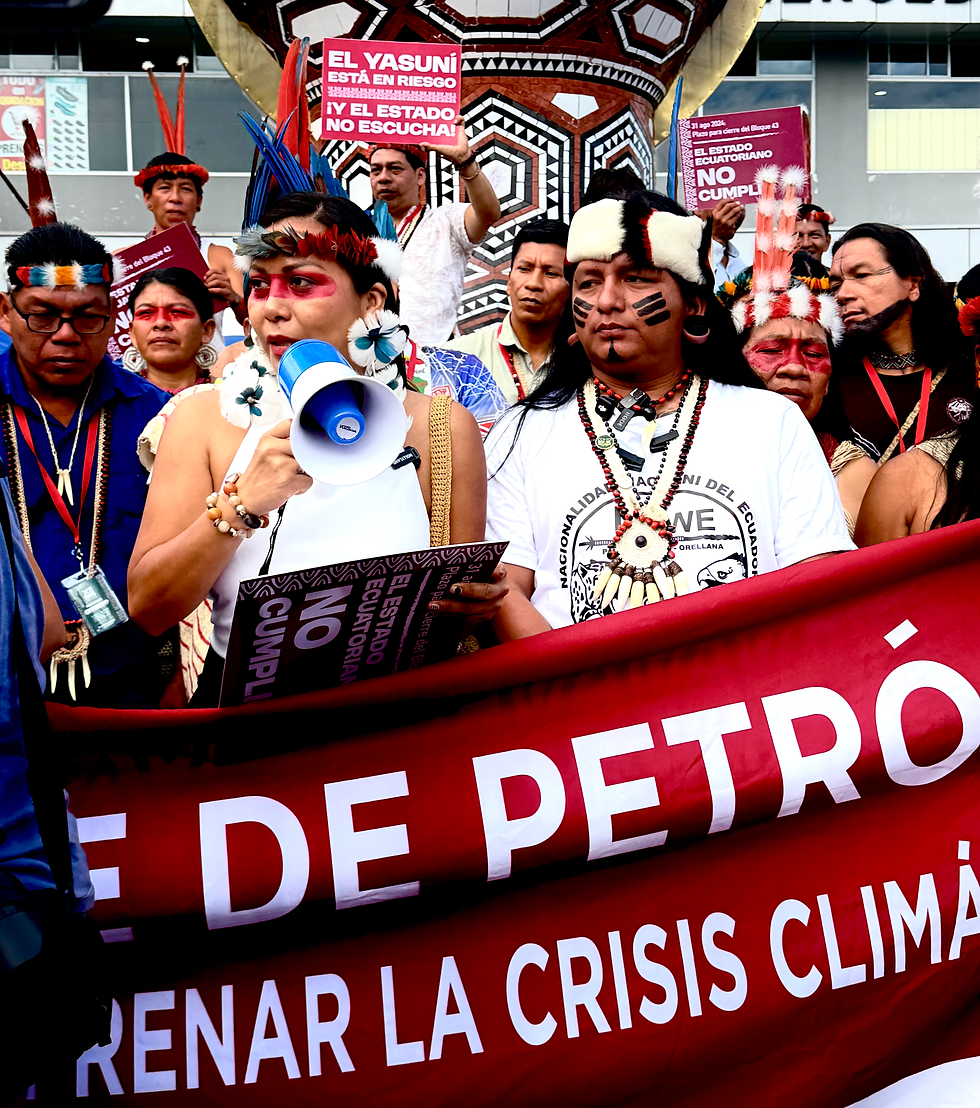
The streets of Puyo, Ecuador, were awakened by the march of the Waorani people. Each step represented a people walking in a single direction: to assert their right to a territory free from exploitation—specifically, free from oil.
The timing of the mobilization could not have been better, coinciding with the Pan-Amazon Social Forum and the presence of organizations and movements from the region's nine countries.
“We know that this is not a fight the Waorani people can wage alone if we want to secure this for the next generation. We need to unite and strengthen one another, as brothers and sisters. That is why I call upon you—on behalf of the Waorani nation and as peoples of the Amazon basin—to join together in defense of our territory.”

In August 2023, Ecuador asked its citizens in a referendum: “Do you agree that the Ecuadorian government should keep the ITT oil fields, known as Block 43, underground indefinitely?”
More than 18 million Ecuadorians—equivalent to nearly 60% of the country's population—answered “yes.” This decision is legally binding and protects Yasuní National Park, home to the Waorani as well as the Tagaeri and Taromenane peoples, who are considered the last groups in Ecuador living in voluntary isolation.
The Waorani themselves only made contact with the outside world starting in the 1950s. Yet, they continue to live off the land, rivers, and forests in deep connection with nature, as explained by Nemo Guiquita, a representative of the Confederation of Indigenous Nationalities of Ecuador (CONAIE):
“Yasuní is sacred territory for us; it is the land of our ancestors, the land of our spirits. Yasuní must be respected. Today, we—the children of Yasuní—are here demanding the closure of Block 43”, says Nemo.
Yasuní Park is located in the Ecuadorian Amazon, between the provinces of Orellana and Pastaza. It spans over a million hectares of immense biodiversity, home to—for instance—598 bird species, 169 types of mammals, and more than two thousand plant species. Standing in stark contrast to this is the region's oil exploration, which has been ongoing since 2016 and has a history of spills.
This cloudy Thursday, August 20, 2026, marks three years since the vote to end oil exploration in the park. Yet, the Ecuadorian government continues to resist honoring the will of the people.

“That is why we are here—our grassroots members and leaders standing before you—to say that we no longer want oil in our territory”, stated Nemo.
More than 50,000 barrels of oil per day continue to flow from 247 active wells in Yasuní, even after the Inter-American Court of Human Rights ruled last year that the Ecuadorian government must decommission oil drilling in the park and implement measures for restoration, restitution, and guarantees of non-repetition.
“Democracy is the voice of the people, and today, democracy is not being upheld by the government of Ecuador, as it fails to comply with the ruling—a ruling that is mandatory.”

Leading the march was Juan Bay, president of the Waorani Nationality (Nawe) organization, carrying a formal complaint document. It was delivered to the subnational government of Pastaza province but addressed to the government of Ecuador. The document urges the country to fulfill its obligation: to protect Indigenous peoples and nature from the oil industry.
“Let us remember that rights cannot be sold or negotiated. Rights are invoked, exercised, respected, and demonstrated—so that our lives and our struggle may endure”, concludes Juan.


